
Short answer
Instagram advertising has no fixed price. The ads are charged in Meta's shared auction together with Facebook, and you set the budget yourself. From four Danish webshops we run Meta for, January–October 2026, 1,000 impressions cost about DKK 25–72 across placements. The price comes down to audience, season and how well the ad holds attention.
Understand what drives the cost.
The same engine as Facebook
Instagram advertising runs in Meta's ad tool and shares the auction, targeting and optimisation with Facebook.
Read this sectionThe same engine as Facebook
Instagram advertising runs in Meta's ad tool and shares the auction, targeting and optimisation with Facebook. There's no separate Instagram price. There's a price for reaching the audience you've chosen, on the placement that gives the best result.
So the question is rarely what Instagram costs. It's what it costs to reach your particular customer, and how well your ad holds her attention when she sees it.
That has a practical consequence. In most accounts, the numbers for Instagram and Facebook are one number, because the budget moves freely between them. That goes for the numbers below too.
What it cost at four Danish webshops
The numbers are from four Danish webshops we run Meta for, January–October 2026, with around DKK 500,000 in total ad spend. They cover all of Meta, meaning Instagram and Facebook together, because the budget is spread automatically between them.
- 1,000 impressions (CPM): between about DKK 25 and 72. Two of the four sat between DKK 35 and 50.
- A link click: DKK 3–5 at three of them. The fourth, with lots of repeat buyers and a lot of retargeting, under DKK 1.
- A purchase: from about DKK 20 to 250, depending mostly on order value and on how much of the sales are repeat purchases.
What the numbers mean for you
The full breakdown, and why the numbers range so widely, is in the article on what Facebook advertising costs. In short, there's no single price. The price that matters is cost per purchase compared with what an order is worth to you.
With a CPM between DKK 25 and 72, 10,000 impressions cost between DKK 250 and 720. That says something about what it costs to be seen. It says nothing about what it costs to sell. That difference lies in the creative, in the offer and in how many of the customers have bought before.
How the auction sets the price
Every time there's room for an ad in Reels, Stories or feed, Meta holds an auction. The winner is the ad that delivers the most total value, not the one that bids the most. The value depends on your bid, on how likely Meta thinks it is that the person will do what you're optimising for, and on the quality of the ad.
That's why creative moves the price so much on Instagram. A Reel people watch to the end gets cheaper delivery than one they swipe past, because Meta judges it to be more relevant.
By default you pay per impression. Cost per click and per purchase are worked out afterwards.
What drives the price up and down
Audience size and competition: the narrower and more sought-after the audience, the more you pay per thousand impressions. Season: November is much more expensive than February, because everyone bids at the same time.
And the creative. An ad that people stop at and watch to the end gets cheaper delivery than one they scroll past. It's the only one of these factors you fully control, and it moves the price more than most bid adjustments.
Locked placements push the price up as well. If you choose only Instagram, or only Reels, you bid on a smaller share of the slots, and Meta can't move the budget to where it's cheapest.
When the goal is enquiries
Not everyone advertises to sell products online. For a clinic we run Meta for, an enquiry cost about DKK 145–310 in the first half of 2026, and CPM was between about DKK 60 and 140. Here too, Instagram and Facebook are counted together.
The price per impression is higher than for the webshops, because a local audience is smaller and quickly gets expensive to reach. Whether the price per enquiry is high or low depends on how many enquiries turn into customers and what a customer is worth.
Do Reels, Stories and feed cost different amounts?
Yes. The price per impression differs between placements, and it changes over time. But it's the wrong place to look. A placement with a low CPM can give expensive purchases, and one with a high CPM can give cheap ones.
Look at the results broken down by placement in Ads Manager, and compare cost per purchase. If one placement is consistently more expensive, try new creative made for that exact format before you switch it off. The problem may be a horizontal video cropped into a vertical format rather than the placement itself.
Product data becomes a Shopping ad.
- title
- Organic Tee · Green
- availability
- in_stock
- price
- 40.00 EUR
- color
- green
- size
- M
Choose a variant. The product data and ad update together.
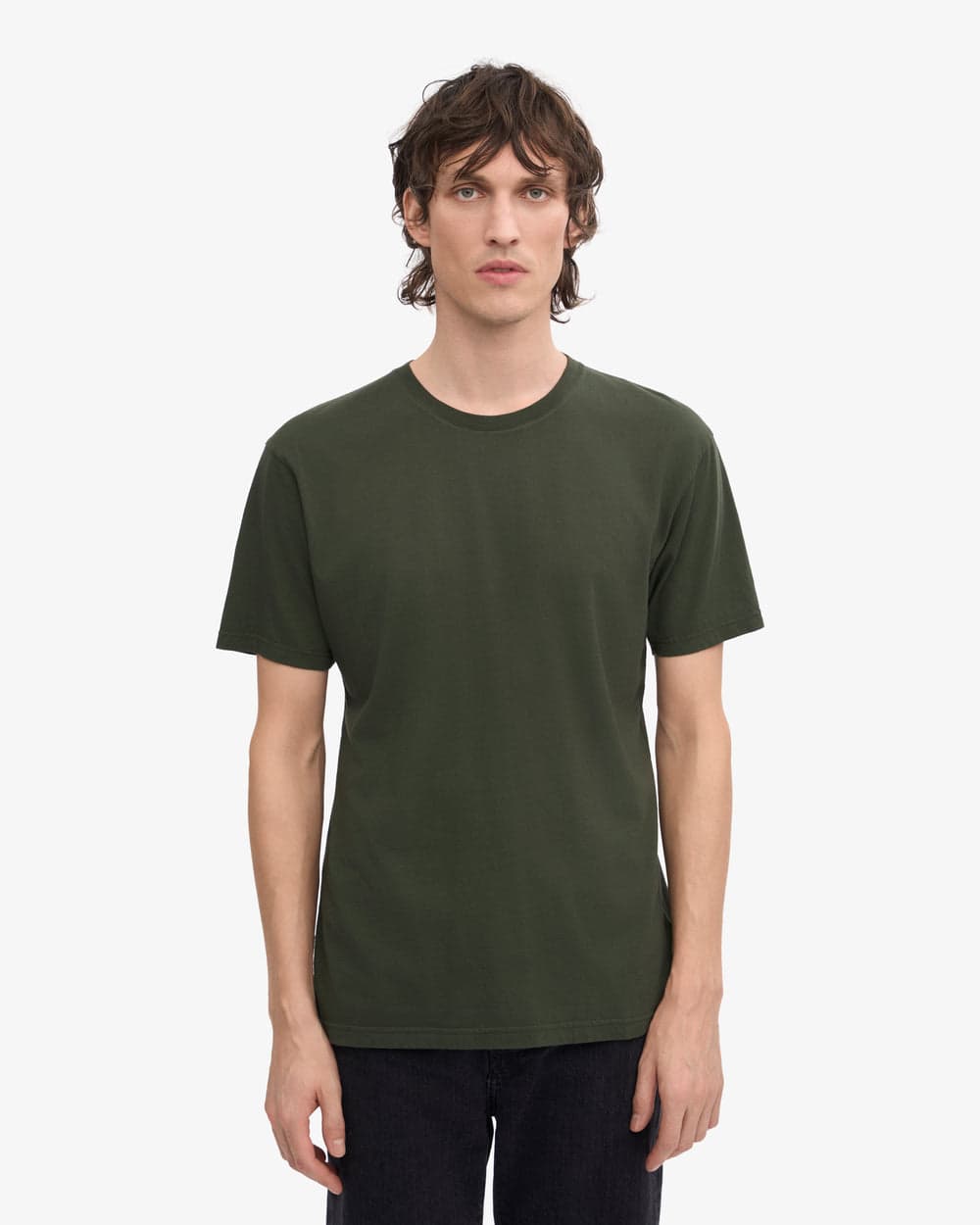

Organic Tee · Green
€40In stock · Example priceFrom Cobiro01ID, title, image and variant describe the actual product being sold.
Minimum budget in practice
There's no official limit that matters for a webshop. The practical limit is the learning phase: Meta recommends around 50 optimisation events per ad set per week before delivery is stable.
Multiply that by your cost per purchase. At the four webshops, cost per purchase ranged from about DKK 20 to 250, which gives a weekly budget per ad set of between around DKK 1,000 and 12,500. If your budget can't reach that, keep it in one ad set, or optimise for an earlier step in the funnel for a while, such as add to cart.
How to set a budget
Work backwards. What can a customer cost, given your contribution margin? What's your conversion rate? Then you know the cost per click the maths can carry, and so whether your current price is a problem or not.
An example: sell for DKK 700 at a 45% margin and you have DKK 315 to play with per order. If 2% of the people who click go on to buy, you can pay up to around DKK 6 per click before the order breaks even. If only 1% buy, the ceiling is half that.
Then set the budget high enough for the campaign to gather enough conversions to get out of the learning phase. A budget too small to learn gives more expensive results than one that can.
Promote in the app or buy in Ads Manager?
The Promote button in the Instagram app is the quickest way to spend money on Instagram. It uses the same auction, but gives you fewer choices.
A promoted post has fewer objectives and targeting options, and doesn't let you optimise for and measure purchases in the same way. It can be fine for getting a good post in front of more people. For sales, Ads Manager is the right place, because the campaign can learn from the purchases.
Mistakes that make Instagram more expensive
Most accounts that pay too much on Instagram do so for the same few reasons. None of them are about bidding.
- The placement is locked to Instagram or to Reels, so Meta can't move the budget to where it's cheapest.
- The creative only exists in horizontal format and gets cropped in the vertical formats.
- The same ads have run so long that frequency is high and click-through rate has dropped.
- The campaign optimises for clicks or engagement when the goal is sales.
- The budget is split across so many ad sets that none of them get out of the learning phase.
What does it cost to have the ads made?
This is where the range is widest, because it depends on who makes them. Video you shoot yourselves on a phone costs time. Content from creators and customers (UGC) costs a fee per video. A produced clip with a photographer and an editor costs the most, and isn't necessarily what sells best on Instagram.
The most important thing is that new creative keeps coming. One cheap video a month that gets replaced in time often beats an expensive production that runs until it's worn out. What UGC costs, and what you get for the money, is covered in a separate article.
The other bill
Beyond media spend, creative production and day-to-day management cost money. For most advertisers, that's the item that decides the result. An account with three ads that are six months old gets more expensive month by month, whatever you bid.
So include both media spend and production in the budget from the start. Otherwise you spend six months trying to optimise your way out of a creative problem.
At Oaksmond, we price the management per job, based on scope. There's no setup fee, and you pay the media budget straight to Meta.
Frequently asked questions
How much does it cost to advertise on Instagram?
That's up to you, because there's no fixed price. From four Danish webshops we run Meta for, January–October 2026, 1,000 impressions cost between about DKK 25 and 72, and a purchase between about DKK 20 and 250. The numbers cover Instagram and Facebook together, because they're bought in the same auction.
How much does an Instagram ad cost?
A single ad has no price in itself. You pay for the impressions it gets, and the price is set in an auction based on audience, season and how well the ad holds people's attention. That's why the same ad can cost different amounts in January and in November.
What do 1,000 impressions cost on Instagram?
From four Danish webshops we run Meta for, January–October 2026, the price was between about DKK 25 and 72 per 1,000 impressions, and two of the four sat between DKK 35 and 50. The numbers are for Instagram and Facebook together.
Do you pay per click or per impression on Instagram?
Per impression by default, even when the campaign optimises for purchases. With some campaign objectives you can choose to pay per click, but for a webshop, cost per purchase is the number to steer by.
Is Instagram more expensive than Facebook?
Not as a rule. The placements compete in the same auction, and Meta spreads the budget to where the result is cheapest, unless you lock the placement.
Does advertising on Instagram pay off?
It does when cost per purchase is below what an order leaves in contribution margin. Work it out before you start: contribution margin per order times conversion rate gives the highest cost per click you can carry. If your cost per click is above that, the creative, the offer or the page needs improving before you turn the budget up.
What's the minimum budget?
There's no official limit, but the budget has to generate enough conversions for the optimisation to settle. Meta recommends around 50 per ad set per week. If that isn't possible, optimise for an earlier step in the funnel.
From insight to action
See how it applies in practice.

From advertising to relevant enquiries
Dansk Motor Finans illustrates the work of creating demand for financing. See how the message connects to the enquiry.
Read the caseMeta Ads
Discuss your advertising
We discuss audience, message and measurement before recommending the next step.
Choose a time30 minutes · No obligation
Read also: How we run Facebook and Instagram ads
About the author

Nicklas Segatz Mortensen
Growth hacker and fractional CMO with 10+ years' experience and hundreds of millions in managed ad spend behind him. Background from larger Danish and international scale-ups, and from the agency world.
Meet the team